How to Control What Your Internal AI Agents Can Access: 7 Controls
Introduction
You can turn every internal agent into an identity your team can name, scope, stop and audit. How do we control what our internal AI agents are allowed to access?
Give each agent its own identity and an accountable owner, then decide each request from who invoked it. Measure least privilege against real use, keep credentials short-lived, hold a kill switch and log every decision.
Those seven controls treat agents as one more identity type, governed beside human and machine identities in the program you already run. The order matters: find every agent, learn what it reaches and uses, then act on the gap.
Oak, the AI-born identity operating system, governs every AI agent like any other identity. It starts with an inventory of each agent and the human accountable for it.
Key takeaways
- Every agent gets its own identity, never a builder's borrowed credentials.
- Each request is limited to the overlap of invoker rights and agent scope.
- Least privilege is measured against what each agent actually uses.
- Agent reviews follow each agent's risk profile, never a calendar.
- Oak inventories every agent and resolves its accountable human owner.
Why agent access breaks the controls you already run
Many internal agents start life on someone else's credentials. A developer wires the agent to a personal token or a shared service account, and the agent reaches everything that identity reaches.
The agent also outlives the context it was built in. Builders change teams or leave, and the agent keeps running with access nobody reviews.
Scale widens the gap. The 2026 Identity Security Landscape counts 109 machine identities per human.
Borrowed credentials are also how attackers get in. The Verizon 2026 DBIR reports that credential abuse appears somewhere in the attack chain of 39% of breaches.
Oak's research with 201 CISOs and identity leaders (The Voice of 200 CISOs, 2026) heard the blind spot directly:
"I'm sure our developers have created agents and they're running autonomously doing things that I don't know about."
CISO, media technology company with 1,000 to 5,000 employees
That is the real problem behind AI agent access control: many agents run as identities nobody governs.
How do we control what our internal AI agents are allowed to access?
Seven controls cover AI agent permissions, each producing evidence a reviewer or auditor can check.
| Control | Question it answers | Evidence it produces |
|---|---|---|
| 1. Give every agent its own identity | Which agents exist, and whose identity do they borrow? | Inventory with owner and borrowed identity |
| 2. Name an accountable human owner | Who answers for this agent? | Named owner and reassignment record |
| 3. Decide access from who invoked the agent | Is this request allowed for this invoker? | Decision tied to invoker and agent scope |
| 4. Measure least privilege against actual use | What does the agent use, compared with what it holds? | Usage evidence behind every cut |
| 5. Keep access short-lived | How long does this credential live? | Expiry and elevation records |
| 6. Hold a kill switch for every agent | Can we stop it in one action? | Tested revocation path |
| 7. Log every access decision | Can we prove what happened and why? | Decision trail that feeds reviews |
1. Give every agent its own identity
No agent should run on a person's credentials. A dedicated identity can be scoped, reviewed and revoked without touching its builder.
Start with one inventory recording each agent's owner, the people who invoke it and the identity it borrows. The borrowed identity defines what the agent can reach today.
Discovery must go beyond registered agents to SaaS agents, shadow agents and custom agents on on-prem, homegrown and custom systems.
That inventory is the first step of AI agent access governance.
2. Name an accountable human owner
The owner is the human who answers for the agent's access. Record the owner separately from the people who invoke it, since the roles carry different rights.
The owner approves every change to the agent's scope. A new tool or data source goes through the owner, never straight to production.
Ownership is also the trigger for revocation. When the owner moves or leaves, joiner-mover-leaver events should prompt a micro-certification. The agent is reassigned or retired, never orphaned with live access.
3. Decide access from who invoked the agent
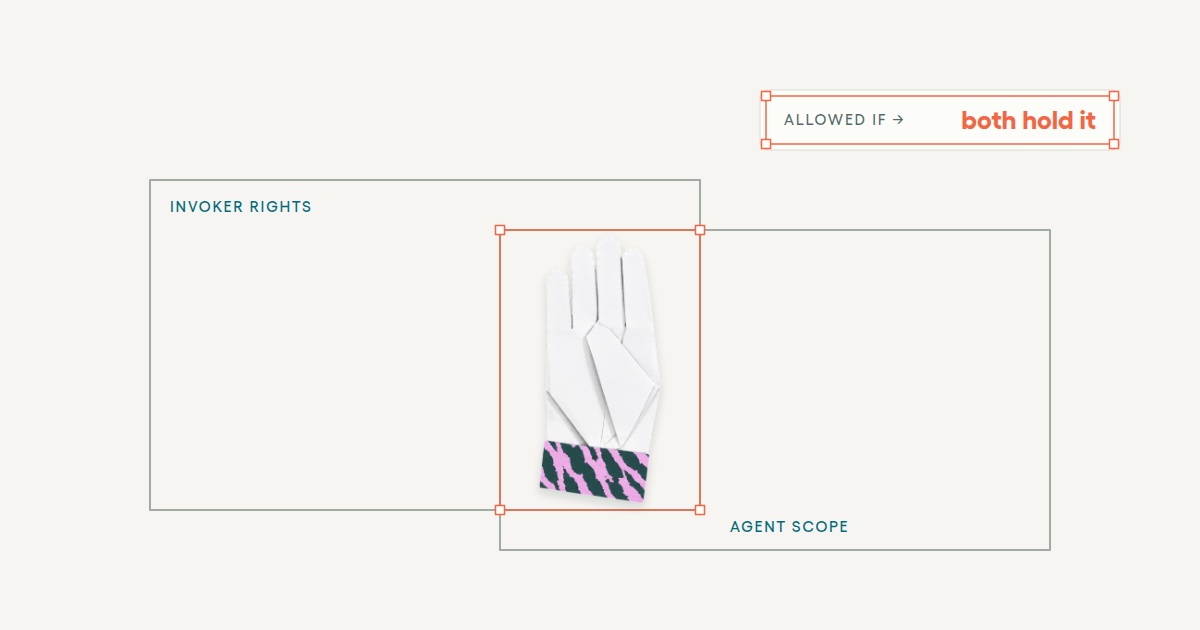
An agent acting on behalf of a person should never exceed that person's rights or its own job. Its effective permission for any request is the intersection of the invoker's rights and the agent's scope.
Without that intersection, delegated access turns into privilege escalation. An IAM lead at an investment firm, interviewed for the same research, described the risk:
"If an agent is assuming my identity... say I have access to [our IGA] as an admin, the agent, which is impersonating me, can also create a user."
IAM lead at an investment firm
Per-call policy is how this should work: each tool call is checked against who asked, the agent's scope and the target's sensitivity.
- Reads within scope: allowed when both the invoker and the agent hold the right.
- Writes to sensitive data: allowed only with the invoker's rights plus an explicit approval.
- Admin actions: routed to a human approver before they run, including creating a user.
4. Measure least privilege against actual use
Under NIST's definition of least privilege, access is held to the minimum necessary for assigned tasks. The definition explicitly covers processes acting on behalf of users, which is what an agent is.
Declared scope tells you what an agent was granted. Real usage tells you what it needs.
Cut what the agent does not use, with its own usage as the evidence. Weigh each grant by privilege level (admin, write, read) and resource sensitivity, so unused admin rights on sensitive data go first.
Oak's activity-based identity graph correlates what every identity can access with what it actually uses, showing not only who has access, but who should. The graph drives usage-based right-sizing, live today in GitHub, Snowflake, Salesforce and Entra ID.
Each change is explained, approved by your team, reversible and on record.
5. Keep access short-lived
Static API keys and long-lived tokens are standing privilege under another name. Issue short-lived credentials scoped to one task or session that expire when the work ends.
Elevation should be requested, never standing. The agent asks, the request is checked against the invoker and the agent's scope, and the grant expires on its own.
The pattern already works for people, where time-bound just-in-time access swaps standing admin rights for a fixed-window grant. Agent credentials should follow the same logic.
6. Hold a kill switch for every agent
A kill switch revokes the agent's identity, tokens and delegated grants in one action. Tie it to the inventory, so the switch reaches every system the agent touches.
Decide who may pull it before you need it.
- The owner: stops the agent at any time, for any reason.
- The security team: stops any agent during an investigation without waiting for the owner.
- The platform team: tests the switch before each agent goes live and after major changes.
An untested kill switch is a hope. Run it outside production and confirm every token and grant is gone.
7. Log every access decision
Every decision record should hold four facts: who invoked the agent, what it requested, what was decided and why. That record is governance evidence for keeping or cutting access.
The same records can stream to your SIEM for detection, which is a separate job.
Every identity needs certifying: service accounts, contractors, RPA bots, and AI agents, each tied to an accountable human owner. For agents, risk-driven access reviews replace the calendar.
Each agent's risk profile, set by privilege level, data sensitivity and usage changes, decides when it comes up for review. Reviewers see the decision trail beside the grant, so keeping access is backed by evidence.
Already running an IGA?
Oak connects to the IGA you already run and covers what it cannot reach: the AI agents, their owners and the access they borrow. Your existing campaigns and provisioning keep running.
Agents then join the same program as human and machine identities: know, own, right-size and control, with the same reviewers and audit trail.
Conclusion
How do we control what our internal AI agents are allowed to access? Treat each agent as an identity with a named owner, a scope measured against use and a revocation path you have tested.
For a CISO or IAM lead, the outcome is a clear answer for the board and the auditor: which agents exist, who answers for each one and why every remaining grant is there.
Oak closes access risk through a Jira or ITSM ticket, with your team approving the change. Oak offers a free white-glove implementation program for qualifying large enterprises.
Get a demo to see your agents, their owners and what each one actually uses.
Frequently asked questions
Is role-based access control enough for AI agents?
No. Roles describe a job a person holds, while an agent's needs change with each request and each invoker. A role sized for the agent's broadest task over-grants every narrower one. Use roles as the outer boundary of the agent's scope, then decide each call against the invoker and the resource's sensitivity. Attribute checks help only when they include the invoker.
Who should own an agent that a whole team built?
One named person, usually the team lead or product owner who decides what the agent is for. A team alias cannot approve a scope change or answer an auditor. Record the rest of the team as maintainers and invokers, and name a deputy owner. If the named owner cannot explain what the agent does, the agent is not ready for production.
Where should a human approve what an agent does?
At irreversible or high-sensitivity actions: creating identities, changing permissions, moving money, deleting data and exporting regulated records. Approving or blocking sensitive tool calls is next on Oak's roadmap, along with fixing agent access from the inventory and risk issues for agents. Today, build approval into the agent's own workflow so the approver sees the request, the invoker and the target first.
How do we govern agents that call other agents?
Treat each agent in the chain as its own identity, and carry the original invoker through every hop. The downstream agent should never hold more rights than the human who started the chain. Without that rule, a low-privilege request can pick up rights at each step. Log the full chain so any action traces back to a person.
What should we do with agents already running on personal credentials?
Move them to dedicated identities without breaking them. Find each agent through the credentials it uses, confirm its owner, then issue a dedicated identity scoped to what the agent actually used recently. Run both in parallel briefly, then revoke the personal token. Start with agents that borrow admin rights or touch sensitive data, since those carry the most risk.
How do access reviews for agents differ from reviews for people?
Agent reviews follow risk events rather than a cycle. A new tool, a jump in usage, an owner change or access to a newly sensitive resource should each trigger a review. The reviewer is the agent's owner, and the evidence is the agent's own usage and decision trail. The question is whether behavior still matches purpose.
Discover related posts