
AI Agent Governance Buyer's Checklist: 10 Questions to Ask Every Platform
Ten questions that separate seeing agents from governing them
This AI agent governance checklist gives you ten questions that separate platforms that only show AI agents from platforms that govern them. Ask whether a platform can find every agent, resolve its accountable owner, right-size its access from real usage and control what it does.
Then ask whether it covers your systems, closes what it finds and runs beside your IGA.
Make each vendor answer on your own data. The standard behind every question is the same: govern every AI agent like any other identity.
Oak, the AI-born identity operating system, builds that standard on an activity-based identity graph of every human, machine and AI agent identity. It shows not only who has access, but who should.
Each question below names what good looks like, the proof to request, and where Oak answers it today.
Key takeaways
- Proof: ask every AI agent governance platform to answer on your own data.
- Model: know, own, right-size and control each agent like any other identity.
- Evidence: right-size agents from their own usage, never from a role guess.
- Fit: Oak connects to your existing IGA and covers what it cannot reach.
How to use this AI agent governance checklist
Score each platform on what it proves in your environment, because demo datasets hide the hard cases. Bring the agents you know about, and ask the vendor to find the ones you don't.
The first six questions follow one model. Govern every AI agent like any other identity: Know, Own, Right-size, Control.
- Know: one inventory with each agent's owner, the people who invoke it and the identity it borrows.
- Own: an accountable human, plus the people who invoke it.
- Right-size: cut what it doesn't use, with its own usage as evidence.
- Control: approve what it calls.
The last four questions test coverage and fit.
NIST's National Cybersecurity Center of Excellence titled its NIST NCCoE concept paper "Accelerating the Adoption of Software and AI Agent Identity and Authorization."
Know: questions 1 and 2, discovery and ownership
1. Can it find every agent, including the ones nobody registered?
A credible platform puts SaaS, homegrown, custom and shadow AI agents in one agent inventory. Each record carries the agent's owner, its invokers and the identity it borrows.
Agents multiply faster than teams can register them, and an unregistered agent still runs on somebody's credentials.
Scale rules out manual discovery. The 2026 Identity Security Landscape survey reports 109 machine identities per human, and 40% of machine identities have access to organizational data.
Ask the vendor to show you an agent you never registered, and the identity it runs as.
2. Does it resolve an accountable human owner for each agent?
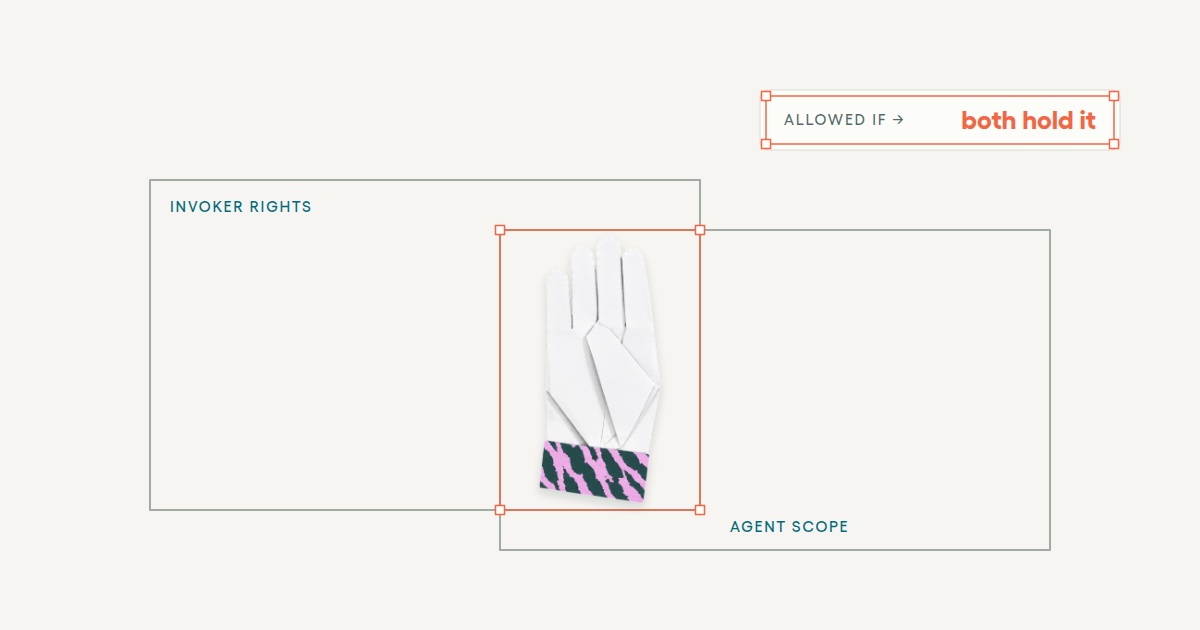
An AI agent owner is the accountable human who answers for that agent's access. The record should also list everyone who invokes it.
Agents often outlive their builders, so the platform has to resolve a new owner when a builder moves or leaves.
Oak's AI agent access governance inventory and owner resolution are live today, tying each agent to an accountable human and its invokers.
Ask the vendor what happens to an agent's owner record the day its builder leaves.
Own and right-size: questions 3 and 4
3. Does it decide access from the invoker, not the builder's credentials?
An agent on its builder's credentials reaches everything the builder can. Invoked by an analyst, it should get only what the analyst's task needs.
The Verizon 2026 DBIR shows why that matters. Credential abuse appears somewhere in the attack chain of 39% of breaches.
Oak's activity-based identity graph, in the Identity Intelligence Layer, correlates what every identity can access with what it actually uses. It then routes risk-prioritized decisions to the right reviewers.
That is the Right-size step: cut what the agent doesn't use, with its own usage as evidence. Usage-based right-sizing is live for GitHub, Snowflake, Salesforce and Entra ID.
Ask the vendor which of an agent's permissions went unused, and what data supports removing them.
4. Can it grant short-lived access instead of standing privilege?
Standing privilege is access an agent holds between tasks, and an attacker inherits it. Short-lived access should be scoped to one task and expire when it ends.
For agents, that typically means session-scoped tokens tied to the invoking user, with elevation requests checked against policy. Ask each vendor which of those controls it ships today.
On the same platform, just-in-time access is live for AWS, 1Password and Okta.
Ask the vendor what access an agent still holds after its task ends.
Control: questions 5 and 6
5. Can it revoke access mid-task and at retirement?
Agent revocation has two moments. Mid-task, you need to stop an agent calling tools it shouldn't, without waiting for a session to expire.
That control should be a per-call policy decision on sensitive tool calls, backed by a kill switch. At retirement, revocation should follow lifecycle management, so the agent's grants leave with it.
Approving or blocking sensitive tool calls is next on Oak's roadmap, alongside fixing agent access from the inventory and risk issues for agents. No date has been set.
Ask the vendor to stop an agent mid-task, then show what it can still reach.
6. Will it produce audit evidence your auditor accepts?
Auditors ask the same of agents as of people: who approved this access, and when was it last checked?
For human accounts, PCI DSS v4.0 Requirement 7.2.4 mandates reviewing user accounts and access privileges at least every six months.
Agents need a different trigger. With continuous access reviews in the Agentic OS, agent reviews run continuously from each agent's own risk profile, not a calendar.
The evidence pack should hold each decision, the usage data behind it, and proof that no reviewer certified their own access.
Ask the vendor to export one completed agent review exactly as your auditor would receive it.
Coverage and fit: questions 7 and 8
7. Does it reach SaaS, cloud, on-prem and homegrown systems?
Agents often act inside systems your IGA never onboarded, such as homegrown apps and on-prem databases. A platform that reads only SaaS misses them.
Oak's ConnectAny connector engine builds integrations for on-prem, homegrown and custom systems. The platform connects through pre-built and custom connectors, file upload, direct API and database connections, and an on-prem agent.
Answers arrive as each system connects, with your incumbent tools still running.
Ask the vendor to connect and govern a homegrown app during the evaluation.
8. Does it hold human, machine and AI agent identities to one standard?
A separate agent console splits the evidence your auditor wants in one place. Agents belong under the same ownership and review rules as every other identity.
Every identity needs certifying: service accounts, contractors, RPA bots, and AI agents, each tied to an accountable human owner.
Ask the vendor for one access review that covers a contractor, a service account and an agent together.
Action and fit: questions 9 and 10
9. Does it close the loop, or stop at a finding?
A finding without a fix is another queue. Visibility shows you the agent, context shows why its access is risky, and action closes the risk.
The Acorns, the governance agents in the Agentic OS, trace each risk to its root cause. They close it through a Jira or ITSM ticket, or fix it directly where you grant write access.
Every change is explained, approved by your team, reversible and on record.
Ask the vendor to trace one risk through to a closed ticket, approval attached.
10. Does it run beside the IGA you already have?
Your IGA holds the certified record for human access. The right platform adds to that program and starts with what it has never seen.
Already running an IGA? Oak adds agents and homegrown apps your IGA never reached: it connects to the IGA you already run and covers what it cannot reach.
Ask the vendor which of your existing IGA workflows stay exactly as they are.
The ten questions at a glance
| Question | What good looks like | Evidence to request |
|---|---|---|
| 1. Finds every agent | One inventory, including unregistered agents | An agent you never registered |
| 2. Resolves owners | Accountable human plus invokers | Owner record after a builder leaves |
| 3. Decides from the invoker | Access correlated with actual use | Unused permissions and supporting data |
| 4. Short-lived access | Task-scoped grants, no standing privilege | Access held after a task ends |
| 5. Revokes mid-task and at retirement | Per-call policy and lifecycle-driven removal | A live stop and residual reach |
| 6. Audit evidence | Risk-driven agent reviews, no self-certification | An exported agent review |
| 7. System reach | SaaS, cloud, on-prem and homegrown | A homegrown app, governed |
| 8. One standard | Every identity in the same reviews | A mixed-identity access review |
| 9. Closes the loop | Ticket or approved direct fix | A finding traced to a closed ticket |
| 10. Runs beside your IGA | Adds coverage, keeps workflows | Workflows that stay unchanged |
Choose the platform that acts on what it finds
A finished AI agent governance checklist should leave you with a platform that acts, with your team approving every change.
For a CISO, that means a smaller attack surface to show the board, and for an IAM lead, least privilege that sticks for every agent.
Oak offers a free white-glove implementation program for qualifying large enterprises.
Get a demo to run these ten questions against your own agents.
Frequently asked questions
How should I check a vendor's own security posture?
Start with its attestations, then examine the access the platform itself needs. Oak's platform is SOC 2 Type II certified and ISO 27001 aligned, and data handling terms are in Oak's privacy policy. For any vendor, ask what permissions its connectors hold and how you revoke them at contract end.
Does Oak publish pricing?
No, Oak has not published pricing, so cost is scoped in a demo against your systems and identities. When comparing quotes, weigh what each vendor covers on day one against what needs custom integration work. Homegrown and on-prem systems are typically where that effort lands.
Do state AI laws change what an identity platform needs to do?
They mostly add documentation and disclosure duties on top of identity controls. AI laws typically focus on risk assessments, disclosures and model behavior, which legal and GRC teams own. Owners, least privilege, revocation and review evidence give those teams the access record a regulator asks for.
Who should own AI agent governance inside the enterprise?
The identity team should run it, with security and the business sharing accountability. IAM already runs inventory, ownership, reviews and revocation for human and machine accounts. Security sets risk policy for sensitive tool calls, and each business unit names the accountable owner for its agents.
How is an AI agent different from a service account?
An agent decides at run time which tools to call and acts for whoever invokes it, while a service account repeats a fixed job. Its configuration predicts less, so usage evidence carries more weight. Both still need an accountable human owner and access sized to real use.
What should a vendor demo prove before you shortlist it?
It should prove the product works on your systems, live, in one session. Run the questions as a script: connect a homegrown system, find an unregistered agent, name its owner and list its unused permissions. End with one remediation whose approval and reversal path appear on record.
Discover related posts