Machine Identity Governance Best Practices, From Creation to Retirement
Introduction
Machine identity governance best practices follow one lifecycle: register each machine identity with an owner and a purpose, then approve it before credentials are issued. Cut standing privilege, rotate credentials, review access against actual usage, watch for drift and dormancy, and remove each identity at the source.
The scale is why this matters. The 2026 Identity Security Landscape survey of 2,930 security decision-makers found 109 machine identities per human, and 40% of machine identities with access to organizational data.
This guide walks each stage, the failure that typically breaks it, and the evidence that proves the control works.
Oak, the AI-native identity operating system, governs human, machine, and AI agent identities on one live graph.
Key takeaways
- Give each machine identity a named owner and purpose at creation.
- Approve scope before issuing credentials, then grant time-bound access over standing rights.
- Review what each identity can access against what it actually uses.
- Oak grounds machine identity governance best practices in what each identity actually uses.
- Retire identities in the target system, not only in the governance record.
Why machine identities need a lifecycle, not a list
Machine identities are created by pipelines, scripts and engineers, not by HR. No joiner-mover-leaver feed announces them, so they often never enter the identity governance and administration (IGA) process at all.
They often outlive the people who made them. The engineer changes teams, the project ends, and the service account keeps its credentials and its access.
An inventory is a snapshot of what existed on the day you counted. Governance is a lifecycle with a named owner and a control at each stage, from the first credential to the last revocation.
Already running an IGA? Oak connects to the IGA you already run and covers what it cannot reach, including the machine identities it cannot tie to a person.
Creation and registration: record an owner and a purpose
Governance starts the moment a machine identity is created. Register it then, before it holds any access, with the fields each later stage depends on.
- Owner: a named human or team accountable for the identity, not whoever ran the pipeline.
- Purpose: the workload or business process the identity serves, written so a reviewer can judge it.
- System: the platform, account or application where the identity lives and acts.
- Credential type: key, secret, certificate or token, so rotation can be planned at issuance.
Registration covers what you create from now on. Discovery covers what already exists, which often includes identities created outside any process in on-prem and homegrown systems.
Oak reaches on-prem and homegrown systems, collects and classifies each machine identity into one canonical taxonomy, and resolves a named human or team owner.
The common failure here is an owner field that records the creator, and the creator has left. The identity is now orphaned, with nobody accountable for its access, its credentials or its retirement.
Approval before credentials are issued
Approve a machine identity before it receives a credential. The approver checks that the stated purpose justifies the requested scope, and the credential exists only once that check passes.
NIST SP 800-207A describes zero trust as a shift toward identity-based controls, which requires authentication and authorization policies based on application and service identities in addition to the underlying network parameters and user identities. The approval gate is where that service identity first gets its authorization defined.
Tie the approval to the registration record: owner, purpose, system and scope. Keep the approver separate from the requester, so the record shows nobody approved their own request.
The common failure is a pipeline that issues the credential at deploy time and a ticket that records approval afterward. The paperwork exists, but it approved nothing.
Oak attributes every action to its trigger: a person, a script or an agent. Credential issuance is one of those actions, so the record shows who or what issued each credential.
Standing privilege reduction and just-in-time access
Scope each machine identity to its workload, not to the team that owns it. A deployment identity needs write access to its own targets, not admin rights across the account.
Standing privilege reduction removes rights an identity holds permanently but needs only occasionally. Just-in-time access grants those rights for a bounded task and takes them back when the window closes.
Keep a break-glass path for emergencies. Make it time-bound, logged and reviewed afterward, so the exception never becomes the default.
The common failure is permanent admin granted "to avoid broken deployments." It works, nobody revisits it, and the identity's reach grows past anything its purpose justifies.
Oak grants just-in-time access as time-bound access, writes the expiry into the target system, and keeps break-glass access with an audit trail.
Credential management and rotation
The Verizon 2026 DBIR reports that credential abuse appears somewhere in the attack chain of 39% of breaches. A static machine credential works for whoever holds it, which makes credential hygiene a governance control.
- Inventory the credentials attached to each identity, including secondary keys and tokens.
- Prefer short-lived, automatically issued credentials where the platform supports them.
- Set rotation by risk, so identities with broad or sensitive reach rotate sooner.
- Tie each rotation to the owner, who confirms the dependent workloads still run.
The common failure is a rotation that once broke an unknown dependency. After that outage, nobody rotates the credential again, and its age becomes its risk.
Oak handles credential rotation and right-sizing continuously, as part of the identity lifecycle rather than a separate project.
Reviews that compare access with actual use
A review that asks an owner whether access "still looks right" without usage data invites a rubber stamp. The useful question is narrower: what can this identity reach, and what has it actually used?
The gap between the two is the work. Rights granted but unused are candidates for removal, and the owner certifies what remains.
Every identity needs certifying: service accounts, contractors, RPA bots, and AI agents, each tied to an accountable human owner.
Oak reviews and right-sizes machine identities alongside humans through the Identity Intelligence Layer. It continuously correlates what every identity can access with what it actually uses, then routes risk-prioritized decisions to the right reviewers.
When governing AI agents as identities, drop the calendar. Review each agent continuously, driven by its own risk profile, with access checked against actual usage and excessive permissions removed at the source.
The common failure is a campaign with no usage column. Reviewers approve what they cannot evaluate, and the certification proves only that someone clicked.
Watching for drift and dormancy
Drift is access added after approval, outside the approved scope. It typically arrives as an out-of-band entitlement: access granted directly in the target application that the governance model never sees.
Dormancy is an identity with no activity over a window you set by risk. A dormant identity with live credentials is reach without purpose.
Drift that appears the day after a periodic review stays invisible until the next one.
Treat owner departure as a trigger too. Joiner-mover-leaver (JML) events trigger event-driven micro-certifications, so a leaving owner forces a reassignment or a retirement decision.
The common failure is a dormant account kept "just in case." Nobody can say what it supports, so nobody is willing to remove it.
Oak remediates from the source the moment an identity deviates, and handles dormant accounts and deprovisioning lag continuously.
Retirement: remove at the source
Retirement means the identity stops working, not that its record closes. Revoke the credentials and disable or delete the account in the target system itself.
Before removal, check dependencies against recent usage. An identity with no recent activity can usually go, while one still in use needs its workload moved first.
Disable first, then delete.
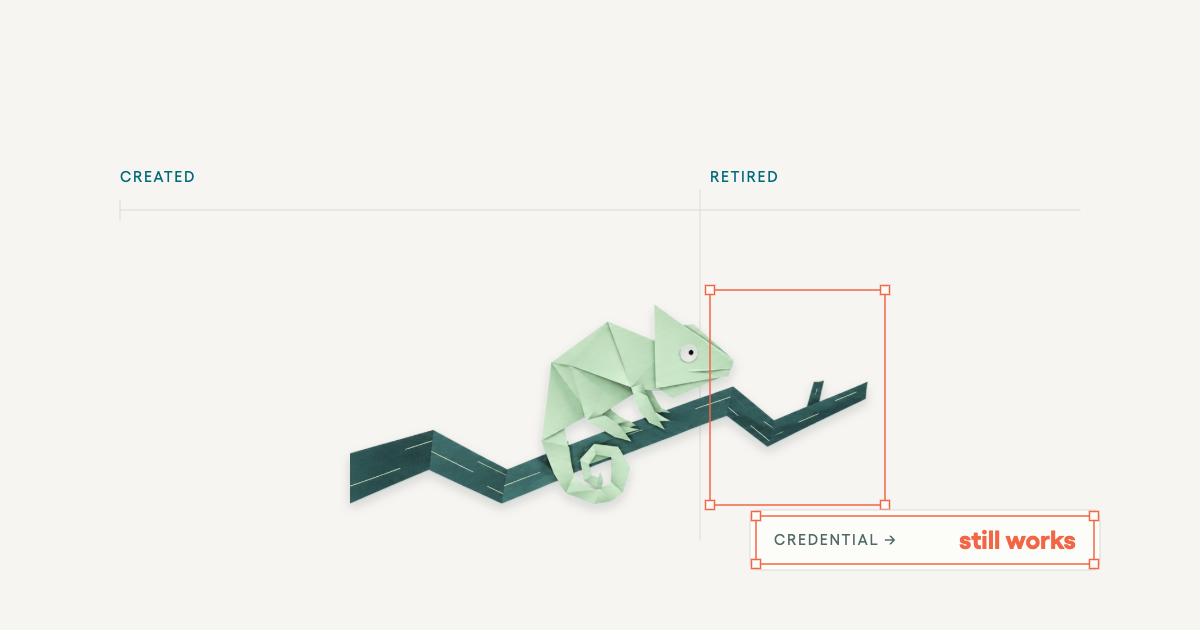
The common failure is a closed record with a valid credential. The governance record shows the identity as retired, while the key still authenticates against the target system.
Retiring identities at the source across legacy and homegrown systems is often where programs stall. Oak offers a free white-glove implementation program for qualifying large enterprises.
Machine identity governance best practices by stage, evidence and failure
Each row names the evidence a working control leaves behind, and the failure that leaves a gap.
| Lifecycle stage | Best practice | Evidence it leaves | Common failure |
|---|---|---|---|
| Creation and registration | Register owner, purpose, system and credential type at creation | Registration record with a named human or team owner | Owner is the creator, who has since left |
| Approval | Approve scope before any credential is issued | Approval record that predates issuance, with a separate approver | Credential issued in the pipeline, approval added later |
| Privilege | Scope to the workload and use just-in-time access | Time-bound grants with expiry in the target system | Permanent admin kept to avoid broken deployments |
| Credentials | Inventory, shorten and rotate credentials by risk | Rotation history tied to the owner | Rotation stopped after an outage |
| Reviews | Certify access against actual usage | Certifications showing removed unused rights | Rubber-stamped campaign with no usage data |
| Drift and dormancy | Detect out-of-band access and inactivity continuously | Findings with a reassignment, removal or retention decision | Dormant account kept just in case |
| Retirement | Revoke credentials and remove the account at the source | Confirmation from the target system that access ended | Record closed while the credential still works |
Conclusion
Machine identity governance best practices work when each stage leaves evidence you can show on demand. For a CISO, that means a defensible answer to the board on who owns each machine identity and what it can reach.
For an IAM lead, it means certifications your team can stand behind and retirements that actually end access. Oak runs that lifecycle beside the IGA you already run.
Get a demo to see how Oak governs machine identities from creation to retirement.
Frequently asked questions
Who should own a machine identity under machine identity governance best practices?
Under machine identity governance best practices, a machine identity's owner is the person or team accountable for the workload it serves. That owner often differs from the technical custodian who manages its keys, so record both, and Oak resolves a named human or team owner.
How often should machine identity access be reviewed?
Machine identity access should be reviewed continuously, with new grants, first use after dormancy and owner departures each triggering a check. Periodic campaigns remain common practice, yet they tell you what happened, never what is happening, so Oak routes risk-prioritized decisions to reviewers as usage changes.
Do machine identity governance best practices apply to AI agents?
Yes, machine identity governance best practices apply to AI agents, plus a record of who each agent acts on behalf of. Give each agent its own identity rather than its builder's credentials. Oak governs human, machine, and AI agent identities on one live graph.
How do machine identity governance best practices fit an existing IGA?
Machine identity governance best practices fit an existing IGA by extending it to the machine identities it cannot tie to a person. Oak connects to the IGA you already run and starts where it stops, including out-of-band entitlements granted directly in applications.
What evidence shows auditors that machine identity governance is working?
Auditors see machine identity governance working through standing evidence of control, not a quarterly scramble: owner records, approvals, usage-based certifications and revocations confirmed at the source. Oak reviews and right-sizes machine identities alongside humans, so one certification process covers both.
Discover related posts