Enterprises have spent years and millions on identity tools and still can't answer the one question the business assumes is solved: who actually has access to what, right now? This is what it takes to answer it, and why we built Oak as an operating system rather than one more tool.
Today, the enterprise runs on identity, and identity runs on a stack that was never designed to work as one. IGA, PAM, ITDR, CIEM, the directory, the HR system: each keeps its own list, on its own model, on its own schedule. The IGA at the center of it governs only what it can correlate to a person. Everything else, every service account, every out-of-band entitlement, every app that never got integrated, sits outside its view.
That would be a problem in any era. Identity is already the number one attack vector into the enterprise. AI has made it acute. Attack tooling that once took a skilled crew and months of work is now a prompt away, so the speed and volume of attacks on identity have exploded. At the same time, AI agents are multiplying inside the enterprise, each one holding credentials, each one a new door, most of them owned by no one. The attack surface is growing faster than any team can review it, and the tools meant to protect it can't see half of it.
Oak was built for exactly this. One platform that connects to everything you run, including the IGA itself, builds a single live graph of every human, machine, and AI agent and what it can actually reach, and acts on what it finds. Not another tool on the pile. The operating system underneath it.
What your IGA can't find, it can't see
Most enterprises we talk to already have an established IGA. It's paid for, it's integrated, and the team runs it well. So why can't it answer the question?
Because an IGA only shows you the identities it can correlate to a person. Every service account, non-human identity, and AI agent it can't tie to a human stays invisible, inside a system you already pay to govern. Same for the fine-grained entitlements granted out of band, directly in the app, that never flowed through a request. Add the on-prem and home-grown applications that take months to integrate and never quite make it onto the roadmap, and the contractors, RPAs, and agents nobody registered, and the real exposure sits in a blind spot no tool you own is watching.
This isn't a failure of the team or even of the product. It's a failure of architecture: identity has plenty of applications and no layer underneath that makes them see the same thing.
That layer is what an operating system provides. A computer's OS does three jobs: it talks to every piece of hardware, it holds one model of everything running, and it schedules the work. Oak does the same three jobs for identity.
Layer one: connect to anything, in hours
Every identity project dies the same death. The first ten integrations go fine. The eleventh is an on-prem app with no API, the twelfth is a home-grown system on a JDBC connection, and the project quietly becomes a two-year program with twenty applications that never connected.
Oak's connector engine is AI-born, which changes the economics. New connectors are built in hours, not months. Modern SaaS and cloud connect in one click through the API factory. On-prem, VDI, home-grown systems, and databases connect through customized connectors the engine generates. A full enterprise environment goes live in days.
Your IGA itself becomes a source. Oak connects to the tools you already run as well as to everything they can't reach, so day one isn't a migration. It's a wider lens on the estate you already have.
Layer two: one live graph of what everything can actually reach
Most identity tools trust the records they're handed. A role label says "standard user," so that's what gets governed. Oak doesn't take the label's word for it.
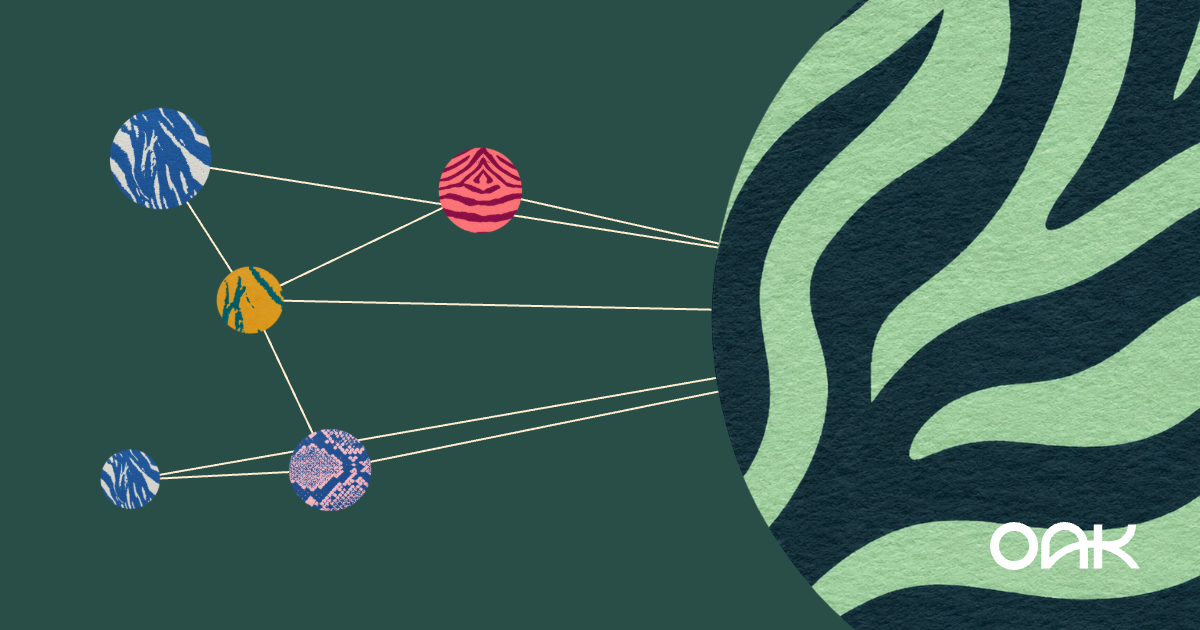
The Identity Intelligence Layer builds the picture bottom-up, from raw evidence: resource-level entitlements, activity logs, and run-time usage, collected from every connected system. It deduplicates and normalizes across sources, then connects every entity into a single live graph. Humans, machines, and AI agents sit on one data model, with the relationships between them intact. The service account inherits from the engineer who created it. The "standard user" can reset any password through three nested groups. The agent runs on its builder's credentials and reaches everything she can.
Because the graph knows granted access and used access side by side, it can tell you the difference between what someone has and what someone needs. That gap is where almost all identity risk lives, and no periodic review has ever been able to see it.
This is the kernel. Every use case, from risk to operations to compliance, runs on it, so every team is reasoning from the same truth.
Layer three: intelligence that acts, and a team that works for you
Visibility that ends in a dashboard is a longer to-do list. Oak is built so that visibility leads to context and context leads to action.
Surface real risk, with blast radius: orphaned accounts, crown-jewel exposure, toxic permission combinations, missing MFA, standing privileged access. Then trace it to the root cause and fix that, not the symptom. The backup script that can read and write the whole database gets right-sized to the one table it needs. The terminated employee still holding live access months later gets closed out automatically. The agent that granted itself CRM write access gets pulled back to read-only.
Then Oak puts a team of AI agents to work beside yours. Acorns run the workflows, policies, reviews, and reporting your team does by hand today. Research, Detection, and Compliance agents ship first, every candidate reviewed before it goes live. Oak Copilot lets you ask the graph anything in plain English and have it investigate and act. And the agentic framework is built in, so your team can spin up its own agents that run on live identity context, continuously.
The result is an identity team that operates by exception. The estate grows; the team doesn't have to.
What runs on it
An operating system is only as useful as what it runs. Here is what runs on Oak today.
Access reviews that reduce risk instead of rubber-stamping it. Every certification arrives pre-filled with last use, permission sensitivity, peer comparison, and a recommendation. Access is certified when it changes, not months later.
Least privilege that runs itself. Role mining, just-in-time access, and lifecycle management as one system rather than three features. Oak mines the role model from what identities actually use, makes everything outside it a time-bound request, and keeps the model true as people join, move, and leave.
Standing evidence of control. Segregation-of-duties conflicts, overdue certifications, and audit evidence gaps surface as audit-ready findings, so compliance stops being a quarterly scramble.
Agents as first-class identities. Every agent in the estate discovered, resolved to an accountable owner, scored by its effective reach, and held to the same continuous review as every human beside it.
Within hours
Most teams see identities they didn't know they had within hours of integration. Not because they were careless. Because no tool they owned was built to look.
And since the real barrier to a new identity backbone isn't capability but migration, we take that on too. Oak White Glove embeds a dedicated identity services team in your infrastructure to build, migrate, and run the program with you until Oak runs at full strength.
"Oak builds the access graph bottom-up and acts on the root cause, instead of handing you one more list of problems. The approach this market needs."
— Stephen Washington Jr., Global Head of IAM, Cargill
If you want certainty about who and what has access across your whole estate, twenty minutes is worth your time.
Built for giants. Born complete.
Discover related posts